
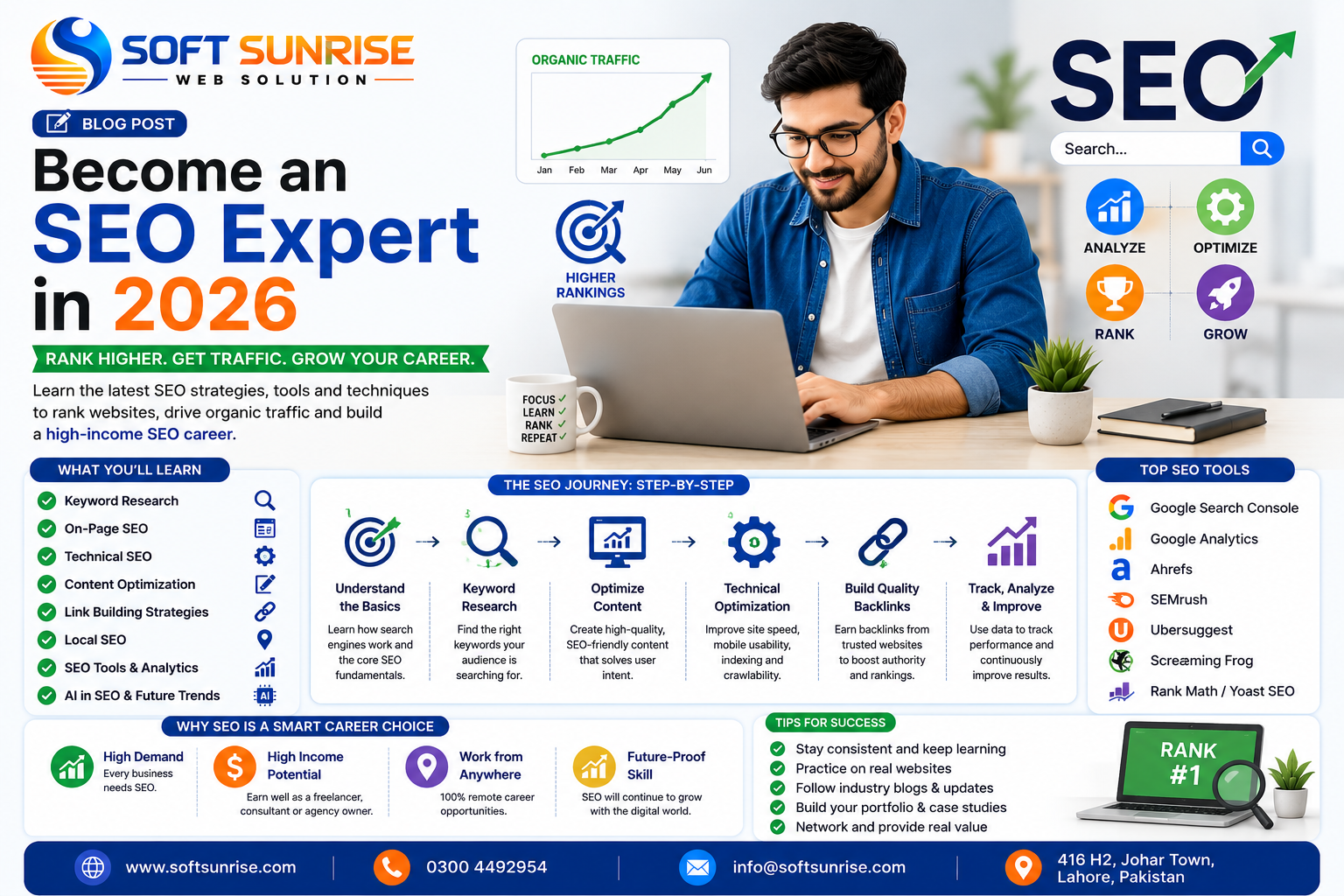
Become an SEO Expert in 2026: A Complete Beginner-to-Professional Guide
Search Engine Optimization has changed significantly. SEO in 2026 is no longer about stuffing keywords into pages, publishing hundreds of generic articles, or collecting as many backlinks as possible.
Search engines are becoming better at understanding intent, content quality, website experience, authority, entities, and user needs. At the same time, AI has dramatically changed how people research, create content, and discover information online.
But SEO is far from dead.
Businesses still need to be discovered when potential customers search for their products, services, and solutions. The methods are evolving, but the fundamental objective remains:
Help the right audience discover useful content at the right time—and turn that visibility into business results.
If you want to become an SEO expert in 2026, you need more than a list of tricks. You need to understand how search works, develop technical and marketing skills, use data correctly, and adapt as search technology changes.
This guide provides a practical roadmap.
What Is SEO?
SEO — Search Engine Optimization — is the process of improving a website's visibility in organic search results.
Suppose someone searches:
“Best web hosting company in Lahore”
Search engines need to determine which pages are most useful and relevant to that query.
SEO helps search engines understand your website while improving the experience for the people visiting it.
A successful SEO strategy can help a business generate:
Visibility → Traffic → Leads → Customers → Revenue
Traffic alone isn't the objective.
Ten visitors who genuinely need your service can be more valuable than 10,000 irrelevant visitors.
Why Learn SEO in 2026?
SEO combines technical skills, content, marketing, research, analytics, and business strategy.
That makes it useful across many industries.
An SEO professional can work as:
- Freelancer
- In-house SEO specialist
- SEO consultant
- Agency professional
- Content strategist
- Technical SEO specialist
- Local SEO specialist
- E-commerce SEO specialist
- SEO agency owner
SEO skills can also be valuable if you run your own website or online business.
Instead of depending entirely on paid advertising, you can build an additional source of customer acquisition through organic visibility.
The 7 Core Skills Every SEO Expert Should Learn
1. Understand How Search Engines Work
Before learning SEO tools, understand the fundamentals.
Search engines generally need to:
Discover → Crawl → Render → Index → Understand → Rank → Serve
Crawling
Search engines use automated crawlers to discover pages and follow links.
Indexing
After discovering a page, a search engine may process and store information about it in its index.
Not every crawled page is necessarily indexed.
Ranking
When someone performs a search, search systems evaluate relevant indexed content and determine which results should appear.
Understanding this process helps explain why issues involving robots directives, internal linking, canonicalization, JavaScript rendering, redirects, duplicate pages, and site architecture matter.
2. Master Keyword Research
Keyword research helps you understand what your target audience is searching for.
But modern keyword research isn't simply finding phrases with high search volume.
You need to understand search intent.
Consider:
“What is web hosting?”
The person is probably looking for information.
Now consider:
“Buy WordPress hosting Pakistan”
That user appears much closer to making a purchase.
These searches require different pages.
Common Search Intent Categories
| IntentUser GoalExample | ||
| Informational | Learn something | What is web hosting? |
| Navigational | Find a specific site/page | Facebook login |
| Commercial Investigation | Compare options before buying | Best hosting companies in Pakistan |
| Transactional | Take an action or purchase | Buy WordPress hosting |
An SEO expert doesn't simply target keywords.
They understand why the search is happening and create the right content for that intent.
3. Learn On-Page SEO
On-page SEO involves optimizing individual pages so they are understandable, useful, and relevant.
Important elements include:
- Page titles
- Headings
- Content structure
- Internal links
- URLs
- Image optimization
- Alt text
- Topic coverage
- Search intent
- Structured data where appropriate
- User experience
Your primary keyword can help guide the page, but don't repeat it unnaturally.
Write for people first while making the topic clear to search engines.
Use Proper Heading Structure
A page should generally have a logical hierarchy:
H1 — Main Topic
H2 — Major Sections
H3 — Subsections
Headings aren't decoration. They help organize information for both readers and machines.
4. Learn Technical SEO
Technical SEO is where many beginners become uncomfortable because it requires understanding how websites actually work.
That discomfort is exactly why learning it can differentiate you.
Important technical SEO topics include:
- Crawling
- Indexing
- XML sitemaps
- robots.txt
- Canonical URLs
- Redirects
- HTTP status codes
- HTTPS
- Mobile usability
- Site architecture
- Internal linking
- Structured data
- Duplicate content
- Pagination
- JavaScript rendering
- Core Web Vitals
- Server performance
You don't necessarily need to become a full-stack developer.
But an SEO professional should be able to identify technical problems, understand their consequences, and communicate the required solution to a developer.
5. Learn Content Optimization
Content remains central to SEO, but publishing large quantities of generic AI-generated text is not a serious strategy.
Strong content should satisfy the searcher's need.
Ask:
What question brought the user here?
Then make the page genuinely useful.
Good content may include:
- Clear explanations
- Original experience
- Examples
- Comparisons
- Data
- Images
- Videos
- Tables
- FAQs
- Expert insight
- Product information
- Practical instructions
The goal isn't:
“How can I make this article 3,000 words?”
The better question is:
“What information does the user need to solve this problem?”
Sometimes the best answer is 700 words. Sometimes it requires 4,000.
Length alone does not create quality.
6. Learn Link Building and Digital Authority
Links can help search engines discover pages and understand relationships and authority across the web.
But link building is one of the most abused areas of SEO.
Buying hundreds of low-quality links simply because a seller promises a high “DA” is not a sustainable strategy.
Focus on earning or acquiring links that make sense.
Potential approaches include:
- Digital PR
- Original research
- Useful tools
- Industry resources
- Partnerships
- Expert contributions
- High-quality guest contributions
- Linkable assets
- Business citations where relevant
One relevant link from a respected website in your industry can be more valuable than large numbers of irrelevant links.
7. Learn Analytics and Measurement
An SEO professional who cannot measure results is working partly blind.
Learn how to evaluate:
- Organic traffic
- Search impressions
- Clicks
- Click-through rate
- Keyword visibility
- Landing pages
- Conversions
- Leads
- Revenue
- Engagement
- Indexing problems
- Technical performance
Don't report only:
“Organic traffic increased by 40%.”
The client ultimately wants to know:
“Did this growth help the business?”
Good SEO connects search performance to business outcomes.
Essential SEO Tools to Learn in 2026
You don't need every SEO tool available.
Start with tools that help you understand websites and make decisions.
Google Search Console
Google Search Console helps website owners understand how their sites perform in Google Search.
It can provide information about:
- Search queries
- Clicks
- Impressions
- Indexing
- Pages
- Sitemaps
- Core Web Vitals
- Search appearance
For anyone learning SEO, Search Console should be one of the first tools you understand.
Google Analytics
Google Analytics helps analyze website traffic and user behavior.
SEO professionals can use analytics to understand what happens after someone reaches the website.
Ahrefs
Ahrefs provides tools for keyword research, competitor analysis, backlink research, content analysis, and site auditing.
Semrush
Semrush provides SEO, keyword, competitor, content, advertising, and website-analysis tools.
Screaming Frog SEO Spider
Screaming Frog SEO Spider is particularly useful for crawling websites and identifying technical SEO issues.
Rank Math and Yoast SEO
For WordPress websites, Rank Math and Yoast SEO can help manage common SEO settings.
But installing an SEO plugin does not optimize your website automatically.
A green score inside a plugin isn't evidence that a page will rank.
Learn Local SEO
If you want to work with restaurants, dentists, lawyers, plumbers, clinics, real estate companies, salons, repair businesses, or other local businesses, learn Local SEO.
Local SEO can involve:
- Google Business Profile optimization
- Business information consistency
- Local landing pages
- Reviews
- Local citations
- Location relevance
- Local content
- Website optimization
- Reputation management
For example, a business may want visibility for:
“Web hosting company in Lahore”
rather than trying to rank globally for:
“Web hosting.”
The first query may have much stronger commercial value for that particular business.
E-Commerce SEO
Online stores introduce additional SEO challenges.
An e-commerce SEO specialist should understand:
- Product pages
- Category pages
- Product variants
- Filters and faceted navigation
- Duplicate URLs
- Internal linking
- Product structured data
- Out-of-stock products
- Pagination
- Product descriptions
- Reviews
- Image optimization
Ranking thousands of products requires a different strategy from optimizing a five-page business website.
SEO and AI in 2026
AI has changed SEO workflows substantially.
SEO professionals can use AI to assist with:
- Keyword organization
- Content briefs
- Topic research
- Schema drafts
- Data analysis
- Regex generation
- Content ideation
- Competitor analysis
- Coding assistance
- Automation
- Editing
But there is a critical distinction:
Using AI to improve your workflow is different from outsourcing your judgment to AI.
AI can produce incorrect facts, weak recommendations, fabricated information, repetitive content, and technically wrong solutions.
The SEO professional still needs to evaluate the output.
Search Is Expanding Beyond Traditional Results
SEO professionals in 2026 should think beyond traditional blue-link rankings.
People increasingly discover information through different search experiences, including AI-powered interfaces, video platforms, marketplaces, social platforms, and other discovery systems.
That means strong SEO fundamentals should be combined with broader visibility strategies.
Build:
Useful content + Recognizable brand + Strong website + Genuine expertise + Consistent presence
Don't build your entire business around exploiting one ranking loophole.
Loopholes disappear.
Brands survive algorithm changes much better.
Core Web Vitals and Website Performance
SEO experts should understand website performance because user experience and technical quality matter.
Important Core Web Vitals include:
Largest Contentful Paint (LCP)
Measures loading performance of the main visible content.
Interaction to Next Paint (INP)
Measures responsiveness when users interact with the page.
Cumulative Layout Shift (CLS)
Measures unexpected movement of page elements.
But don't make the mistake of treating a perfect performance score as the objective.
A fast website with poor content and no authority will not automatically rank.
Technical performance supports the broader SEO strategy.
A Step-by-Step Roadmap to Become an SEO Expert
Step 1: Learn the Fundamentals
Understand:
Crawling → Indexing → Ranking → Search Intent → Keywords → Content → Links
Don't start with advanced hacks.
Step 2: Build Your Own Website
This is one of the most important steps.
Theory isn't enough.
Buy a domain, build a website, publish content, connect analytics, configure Search Console, and attempt to rank pages.
Real websites expose problems tutorials don't.
Step 3: Practice Keyword Research
Select a niche and identify:
- Topics
- Keywords
- Search intent
- Competitors
- Content opportunities
- Commercial opportunities
Then map keywords to appropriate pages.
Step 4: Learn On-Page Optimization
Take existing pages and improve their structure, content, headings, internal links, metadata, and intent alignment.
Track what happens.
Step 5: Learn Technical SEO
Crawl websites and deliberately investigate:
- Broken links
- Redirect chains
- Duplicate pages
- Indexing problems
- Canonicalization
- Sitemap issues
- Performance
- Mobile problems
Learn why each issue matters before trying to fix everything a tool flags.
Step 6: Build Authority
Create content worth referencing.
Learn outreach, digital PR, partnerships, and ethical link acquisition.
Step 7: Measure Results
Use Search Console and analytics to compare:
Before → Changes → After
Document what you did and what happened.
This becomes the foundation of a case study.
Build an SEO Portfolio Without Clients
You don't need to wait for a paying client before building evidence.
Use your own projects.
Your portfolio can show:
Problem: Website had poor search visibility.
Research: Identified keyword and technical opportunities.
Action: Improved content, internal linking, technical setup, and page structure.
Result: Organic impressions, clicks, rankings, leads, or other relevant metrics improved over a defined period.
Real data is far more persuasive than saying:
“I am an SEO expert with excellent skills.”
Show the work.
How to Get Your First SEO Clients
Once you have practical experience, start looking for businesses with problems you can solve.
Potential sources include:
- Freelancing platforms
- Local businesses
- Agencies
- Referrals
- Professional networks
- Direct outreach
- Your own website
Don't send:
“Hello sir, I am SEO expert. Do you need SEO?”
Identify something specific.
For example:
“I noticed several of your important service pages aren't appearing in Google Search, and some pages have duplicate title tags. I can audit the site and prioritize the issues most likely to affect organic visibility.”
Specific observations create credibility.
SEO Services You Can Sell
Once you're competent, potential services include:
- SEO audits
- Keyword research
- On-page SEO
- Technical SEO
- Local SEO
- E-commerce SEO
- Content strategy
- Competitor analysis
- Link acquisition
- SEO reporting
- WordPress SEO
- Website migrations
- SEO consulting
- Monthly SEO management
You can eventually specialize.
For example:
SEO for Dental Clinics
or:
WooCommerce SEO Specialist
A specialist often has a stronger positioning than someone claiming to provide every digital service imaginable.
Common SEO Mistakes Beginners Make
Avoid these:
- Keyword stuffing
- Copying competitor content
- Publishing unchecked AI content
- Buying bulk backlinks
- Obsessing over third-party authority scores
- Ignoring search intent
- Ignoring technical SEO
- Targeting only high-volume keywords
- Reporting rankings without conversions
- Installing plugins and assuming SEO is complete
- Changing strategy every week
- Promising guaranteed #1 rankings
Be especially careful with the last one.
No legitimate SEO professional controls Google's rankings.
You can improve the probability of strong performance. You cannot honestly guarantee a specific organic ranking.
How Long Does It Take to Become Good at SEO?
You can learn basic SEO concepts relatively quickly.
Becoming genuinely competent takes longer because SEO requires experience.
You need to encounter:
- Failed experiments
- Successful pages
- Indexing problems
- Ranking changes
- Website migrations
- Algorithm updates
- Competitive niches
- Technical problems
- Client constraints
Don't spend two years collecting courses before touching a website.
Learn the fundamentals, then start experimenting.
Experience is where SEO knowledge becomes SEO judgment.
What Makes a Great SEO Expert in 2026?
The strongest SEO professionals won't simply memorize ranking factors.
They will combine:
SEO + Content + Technical Understanding + Analytics + Marketing + AI + Business Strategy
They understand that rankings are a means to an end.
A business doesn't need position #1 merely for bragging rights.
It needs:
Visibility → Qualified Traffic → Leads/Sales → Growth
That is the mindset clients pay for.
Final Thoughts
Becoming an SEO expert in 2026 is not about discovering a secret formula for ranking websites.
It is about developing a combination of technical, analytical, content, marketing, and problem-solving skills.
Start with the fundamentals.
Build your own website.
Learn keyword research.
Optimize real pages.
Understand technical SEO.
Study analytics.
Experiment.
Document results.
Build case studies.
Then start solving problems for clients.
The path looks like this:
Learn → Practice → Analyze → Optimize → Measure → Improve → Specialize
AI and search technology will continue to change.
Specific tactics will come and go.
But professionals who understand how people search, how websites work, how content creates value, and how search visibility connects to business results will continue to have valuable skills.
Comments (0)
Leave a Comment