
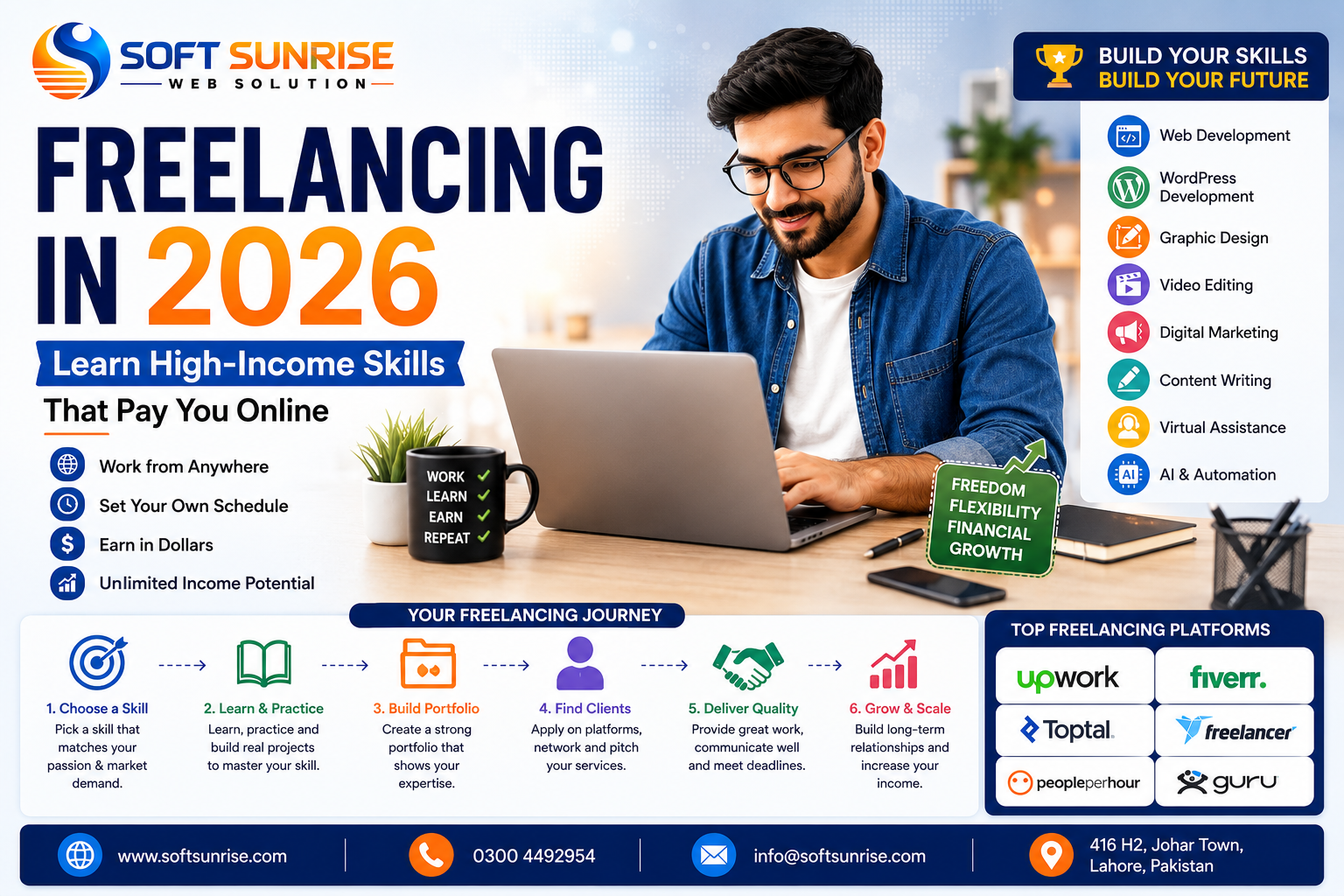
Freelancing in 2026: Learn Skills That Pay You Online
Freelancing has changed dramatically over the last few years. In 2026, businesses can hire developers, designers, marketers, writers, video editors, virtual assistants, and specialists from almost anywhere in the world.
That creates a genuine opportunity for people who want to build an online career.
But freelancing is often presented incorrectly.
Creating an account on a freelance marketplace does not make you a freelancer. Buying a course does not guarantee clients. And AI tools have not eliminated the need to develop real skills.
Successful freelancing follows a much simpler model:
Learn a valuable skill → Solve real problems → Find clients → Deliver quality work → Build reputation → Increase your value
This guide explains how beginners can start freelancing in 2026, which skills have commercial potential, where to find clients, and how to build a sustainable freelance career.
What Is Freelancing?
Freelancing means providing professional services to clients without working as a permanent employee for a single organization.
A freelancer may work with one client or several clients simultaneously and may charge:
- Per project
- Per hour
- Per milestone
- Monthly retainer
- Based on a defined service package
For example, a WordPress developer might charge a fixed price for building a business website and then offer an ongoing monthly maintenance package.
A social media manager could charge a monthly retainer for content creation and account management.
The fundamental principle is the same:
A client has a problem. You have the expertise to solve it. The client pays you for that value.
Why Freelancing Is Still Relevant in 2026
Freelancing isn't disappearing. What is changing is the type of work clients are willing to pay for.
Basic tasks that can easily be automated are becoming less valuable. Businesses increasingly need freelancers who combine technical skills, communication, problem solving, business understanding, and effective use of AI.
That means simply knowing how to use a tool is no longer enough.
Clients want outcomes.
They don't necessarily want “a WordPress expert.”
They want:
A website that helps their business attract customers.
They don't want someone who merely knows video-editing software.
They want:
Videos that hold attention and help grow their audience.
The closer your work is to solving a real business problem, the more valuable your skill becomes.
Benefits of Freelancing
Freelancing can provide significant flexibility, but it also comes with responsibility.
Work From Anywhere
Many freelance services can be delivered remotely. Your client might be in Lahore, Dubai, London, Toronto, New York, or somewhere else entirely.
Your location becomes less important when your work can be delivered digitally.
Access Global Clients
Online platforms, professional networks, communities, and direct outreach allow freelancers to work with businesses beyond their local market.
This can significantly expand the number and type of opportunities available.
Control Your Schedule
Freelancers often have greater control over when they work.
But flexibility shouldn't be confused with having no schedule.
If anything, successful freelancing requires strong time management because there may be no manager reminding you about every deadline.
Build Multiple Income Sources
A freelancer can potentially earn through:
Projects + Monthly retainers + Consulting + Digital products + Training + Affiliate partnerships
You don't need to build all of them immediately. Client services are usually the simplest starting point.
Build Your Own Professional Brand
Every successful project can contribute to your:
Portfolio → Reviews → Testimonials → Case Studies → Referrals → Reputation
Over time, this can reduce your dependence on freelance platforms.
High-Demand Freelancing Skills to Learn in 2026
There is no magical “best skill.”
A useful skill needs three things:
Market demand + Your ability to become competent + Customers willing to pay
Here are several strong categories to consider.
1. Web Development
Businesses still need websites, landing pages, e-commerce stores, portals, integrations, and custom web applications.
Useful technologies may include:
- HTML
- CSS
- JavaScript
- PHP
- React
- Next.js
- APIs
- Databases
- Git
- Cloud deployment
AI can accelerate development, but clients still need people capable of understanding requirements, architecture, debugging, security, performance, and deployment.
Don't become dependent on generating code you cannot understand.
2. WordPress Development
WordPress remains useful for business websites, blogs, e-commerce stores, membership websites, and many other projects.
Freelance services can include:
- WordPress website development
- WooCommerce stores
- Theme customization
- Plugin configuration
- Custom functionality
- Website migration
- Speed optimization
- Security
- Maintenance
- Bug fixing
The weak positioning is:
“I make WordPress websites.”
A stronger positioning could be:
“I build fast, conversion-focused WordPress websites for service businesses.”
The second communicates business value.
3. Graphic Design
Businesses continuously need visual content.
Services can include:
- Logo design
- Brand identity
- Social media graphics
- Advertising creatives
- Website graphics
- Presentations
- Packaging
- Marketing materials
AI has made basic image creation easier, which means designers need to offer more than simply operating design software.
Understanding branding, typography, composition, marketing, and visual communication becomes increasingly important.
4. Video Editing
The demand for video has expanded across YouTube, Instagram, Facebook, TikTok, advertisements, courses, and corporate marketing.
Freelancers can specialize in:
- Short-form videos
- YouTube editing
- Reels
- Podcasts
- Advertising creatives
- Product videos
- Educational content
- Corporate videos
The valuable skill isn't merely cutting clips together.
It is understanding storytelling, pacing, hooks, retention, sound, captions, and platform-specific content.
5. Digital Marketing
Businesses don't simply want websites. They need customers.
That creates opportunities in:
- Search Engine Optimization (SEO)
- Meta Ads
- Google Ads
- Social media marketing
- Email marketing
- Content marketing
- Conversion optimization
- Analytics
Marketing freelancers should learn to connect their work to measurable business outcomes.
“Posting on Facebook” is a task.
Generating qualified enquiries through Facebook campaigns is a business outcome.
6. Content Writing and Copywriting
AI can generate text quickly, so generic writing has become easier to produce.
That doesn't mean professional writing has become irrelevant.
It means low-value writing faces more competition.
Writers who understand:
- Research
- Brand voice
- SEO
- Sales psychology
- Subject expertise
- Editing
- Fact checking
- Storytelling
can still provide substantial value.
AI can assist with the workflow, but publishing unchecked AI-generated content is not professional writing.
7. Virtual Assistance
Businesses and entrepreneurs frequently need help managing day-to-day operations.
A virtual assistant may handle:
- Scheduling
- Research
- Data entry
- Customer support
- CRM management
- Product uploads
- WordPress updates
- Social media coordination
- Administrative tasks
General virtual assistance can be competitive, so specializing can improve your positioning.
For example:
E-commerce VA
Real Estate VA
WordPress VA
Executive VA
Specialization gives clients a clearer reason to choose you.
8. UI/UX Design
Companies building websites, apps, SaaS products, and digital platforms need interfaces that are easy to understand and use.
Useful skills include:
- Wireframing
- Prototyping
- User research
- Information architecture
- Responsive design
- Design systems
- Conversion-focused layouts
Knowing a design tool is not the same as understanding UX.
The value comes from designing experiences that help users accomplish their goals.
9. Automation and AI Integration
This is one of the more interesting areas in 2026.
Businesses want to automate repetitive processes involving:
- Leads
- Customer support
- CRM updates
- Reporting
- Data processing
- Content workflows
- Internal operations
A freelancer who understands APIs, automation platforms, AI tools, and business processes can build solutions that save clients time and money.
But avoid selling “AI” merely because the term is popular.
Sell the outcome:
“I automate incoming website leads so they are recorded, categorized, and sent to your sales team automatically.”
That is much easier for a business owner to understand.
Which Freelancing Skill Should a Beginner Choose?
Don't choose a skill because someone on YouTube claims they make $10,000 per month from it.
Choose based on four questions:
- Do businesses actually pay for this skill?
- Can I become competent enough to deliver professional work?
- Do I enjoy it enough to practice consistently?
- Can I demonstrate my ability through a portfolio?
If the answer to all four is yes, you have a reasonable starting point.
Where to Find Freelance Clients
Finding clients is a separate skill from doing the work.
Being an excellent developer does not automatically make clients discover you.
Freelancing Platforms
Popular platforms include Upwork, Fiverr, Freelancer, PeoplePerHour, Guru, and Toptal.
These platforms can provide access to clients, but competition can be intense.
Don't build your entire career around one platform.
Your account belongs to the platform ecosystem. Your reputation, portfolio, relationships, and personal brand should belong to you.
Finding Clients Outside Freelance Platforms
Freelancers can also find clients through:
- Facebook groups
- Professional communities
- Local businesses
- Referrals
- Networking
- Cold email
- Direct outreach
- Personal websites
- Content marketing
- Social media
Direct client acquisition is harder initially, but it can become extremely valuable.
You aren't competing beside 50 proposals on every opportunity.
How to Start Freelancing in 2026
Step 1: Choose One Skill
Don't start with:
Web development + Graphic design + SEO + Video editing + Amazon + AI + Social media marketing
You'll become mediocre at everything.
Pick one primary skill.
For example:
WordPress Development
You can add complementary skills later.
Step 2: Learn and Practice
Watching tutorials is not enough.
You need to build things.
If you're learning WordPress, build:
- Business website
- E-commerce store
- Landing page
- Blog
- Booking website
Solve problems without copying every step from a tutorial.
The objective is to reach a point where a client can describe what they need and you can figure out how to deliver it.
Step 3: Build a Portfolio
No clients?
You can still build a portfolio.
Create realistic demonstration projects.
For example, if you want restaurant clients, build a fictional restaurant website containing:
Homepage + Menu + Reservation + Contact + Mobile design
Three strong projects are more convincing than 20 unfinished tutorials.
Step 4: Define Your Service
Don't tell clients:
“I know WordPress.”
Turn your skill into an offer.
For example:
“I design and develop responsive WordPress websites for small businesses, including contact forms, basic SEO setup, speed optimization, and mobile responsiveness.”
Now the client knows what they are buying.
Step 5: Create Professional Profiles
Your profile should clearly communicate:
Who you help + What you do + What result you provide
Avoid descriptions such as:
“Hi sir, I am professional expert and can do any type of work.”
It communicates nothing.
Instead:
“WordPress Developer helping small businesses build fast, professional, mobile-friendly websites.”
Then support the claim with portfolio examples.
Step 6: Start Client Outreach
This is where many beginners fail.
They learn for months but never actually ask anyone to pay them.
Set a consistent routine for:
- Sending targeted proposals
- Contacting potential clients
- Networking
- Publishing useful content
- Following up
- Improving your portfolio
Don't send hundreds of identical messages.
Research the business and identify a real problem.
A message such as:
“I noticed your website's booking page isn't working properly on mobile. I specialize in WordPress sites for service businesses and can help fix the issue.”
is stronger than:
“Hello sir, do you need website?”
How to Write Better Freelancing Proposals
A good proposal should focus on the client's problem.
A simple structure is:
Problem → Understanding → Solution → Evidence → Next Step
For example:
Hi, I reviewed your requirement for improving your WooCommerce store's performance. The issue appears to involve both page-loading speed and the checkout experience.
I can audit the current setup, identify the major bottlenecks, optimize the WordPress/WooCommerce configuration, and test the purchase flow across desktop and mobile.
I've worked on similar WordPress optimization projects and can provide relevant examples.
If you'd like, I can first review the current site and outline the areas I would prioritize.
Short, relevant, and specific beats a generic essay.
Don't Compete Only on Price
Beginners often think:
“If everyone charges Rs. 50,000, I'll charge Rs. 10,000 and win the client.”
You may win some clients.
But you may also attract customers who choose exclusively on price, demand excessive work, and leave as soon as someone cheaper appears.
Price should reflect your:
Skill + Scope + Complexity + Time + Business value + Experience
Being affordable can be part of your positioning.
Being the cheapest person available is not a durable strategy.
Turn Projects Into Recurring Income
One-off projects are useful, but monthly retainers can make freelancing more stable.
For example, after building a website, you might offer:
- Website maintenance
- Security monitoring
- Backups
- Content updates
- SEO
- Hosting
- Analytics reporting
- Technical support
Instead of constantly starting from zero each month, recurring clients create a more predictable revenue base.
Use AI to Become More Productive
AI should make you better at your profession, not replace learning the profession.
A developer might use AI to:
- Explain unfamiliar code
- Generate initial boilerplate
- Debug
- Write documentation
- Brainstorm architecture
- Create test cases
A marketer might use it for:
- Research
- Campaign concepts
- Data analysis
- Drafting variations
- Content planning
A writer might use it for:
- Research assistance
- Outlines
- Editing
- Brainstorming
But you remain responsible for the final output.
If you cannot recognize when AI produces something incorrect, insecure, misleading, or low quality, you're not ready to sell that output professionally.
Common Freelancing Mistakes to Avoid
Beginners repeatedly make the same mistakes:
- Learning endlessly without selling
- Learning too many skills simultaneously
- Copying generic proposals
- Building no portfolio
- Competing only on price
- Accepting projects they cannot deliver
- Missing deadlines
- Communicating poorly
- Depending entirely on one platform
- Ignoring contracts and scope
- Doing unlimited revisions
- Using AI output without checking it
- Stopping outreach once they get busy
Freelancing is both a profession and a business.
You need technical ability and business discipline.
How Long Does It Take to Start Earning?
There is no reliable answer.
Some people find a client quickly. Others spend months developing skills and positioning before landing meaningful work.
Your timeline depends on:
- Existing skills
- Portfolio quality
- Market demand
- Communication
- Outreach volume
- Proposal quality
- Pricing
- Competition
- Reputation
- Consistency
Don't measure progress only by income during the first few weeks.
Measure whether you're becoming more capable and more marketable.
A Better Freelancing Growth Path
Think of freelancing as stages.
Stage 1 — Learn
Develop one commercially useful skill.
Stage 2 — Prove
Build portfolio projects showing you can deliver.
Stage 3 — Sell
Find your first paying clients.
Stage 4 — Deliver
Produce quality work and communicate professionally.
Stage 5 — Build Reputation
Collect genuine testimonials, referrals, and case studies.
Stage 6 — Specialize
Become known for solving a specific type of problem.
Stage 7 — Increase Value
Move toward larger projects, retainers, consulting, or productized services.
The goal isn't to stay a cheap beginner forever.
Freelancing vs Remote Job
These aren't the same thing.
| FreelancingRemote Employment | |
| Multiple clients possible | Usually one employer |
| Income may fluctuate | More predictable salary |
| You find your own clients | Employer provides the work |
| You control pricing | Employer sets compensation |
| Greater flexibility | More structured schedule |
| You manage business operations | Company manages operations |
| Higher uncertainty | Generally greater stability |
Neither is automatically better.
Choose based on how much independence, stability, responsibility, and risk you want.
Can Freelancing Become a Business?
Yes.
A freelancer can eventually move from:
Freelancer → Specialist → Consultant → Small Team → Agency
Suppose you're a web developer with more projects than you can handle.
You might eventually work with:
- Designer
- Developer
- SEO specialist
- Content writer
- Project manager
You focus on sales, strategy, client relationships, and quality control while the team handles parts of delivery.
But don't rush to call yourself an agency when you don't yet have a reliable client-acquisition or delivery system.
First learn how to get and retain customers yourself.
Final Thoughts: Skills Pay, Not Profiles
Freelancing in 2026 can still be a powerful way to build an online income and work with clients around the world.
But creating profiles on six freelancing websites won't create a career.
Your real assets are:
Skill + Portfolio + Communication + Reputation + Relationships + Ability to Solve Problems
Start with one valuable skill.
Practice until you can deliver real work.
Build evidence through your portfolio.
Start approaching potential clients.
Deliver professionally.
Ask satisfied clients for testimonials and referrals.
Then improve your skills, positioning, and pricing.
Don't spend years preparing to freelance. Learn enough to create value, enter the market, and let real projects expose what you need to improve next.
That is how freelancing moves from an online earning idea to a sustainable professional career.
Comments (0)
Leave a Comment