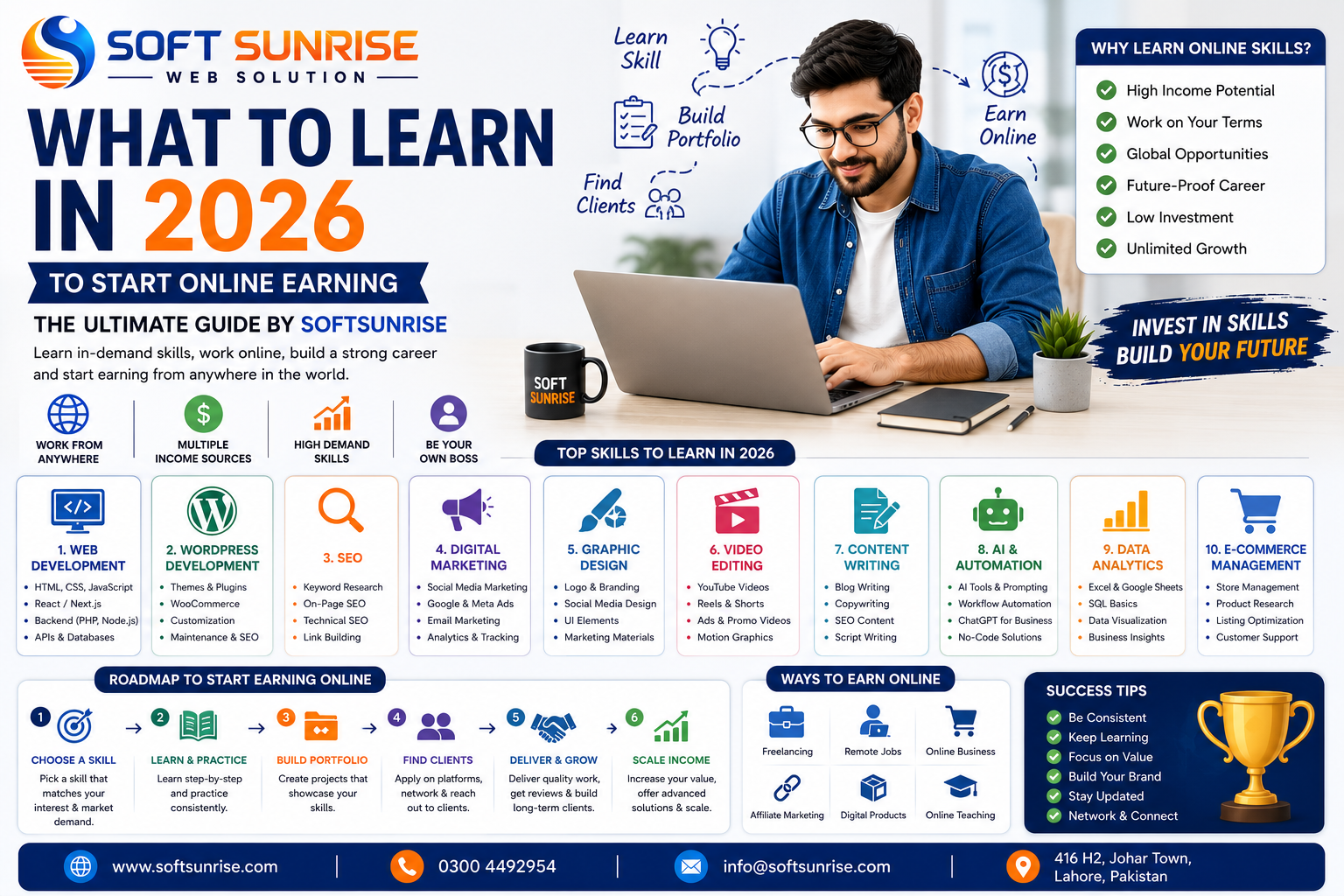
What to Learn in 2026 to Start Online Earning: The Ultimate Guide by SoftSunrise
Online earning in 2026 is not about discovering a secret app, finding a shortcut, or copying whatever business model is trending on social media.
The internet has made it possible to work with clients, businesses, and customers around the world. At the same time, AI and automation have made basic digital work easier to produce, increasing competition for people whose only advantage is knowing how to use a particular tool.
The opportunity is still enormous—but the standard has changed.
The safest path to online earning in 2026 is to learn a skill that solves a real problem, prove you can deliver results, and learn how to sell that value.
This SoftSunrise guide covers the skills worth considering, how AI changes the market, and a practical roadmap for turning a skill into your first online income.
What Does “Online Earning” Actually Mean?
Online earning isn't a business model by itself.
Money still comes from providing value to another person or business. Online platforms simply make it possible to deliver that value digitally.
You might earn through:
- Freelancing
- Remote employment
- Digital services
- E-commerce
- Content creation
- Affiliate marketing
- Consulting
- Digital products
- Online education
- Software and SaaS
Before choosing a platform, choose what value you can provide.
Creating accounts on Upwork, Fiverr, YouTube, or an e-commerce platform won't create income if you don't have something people want.
1. Web Development
Web development remains one of the strongest digital skills because businesses still need websites, applications, portals, dashboards, stores, integrations, and custom systems.
What Should You Learn?
A practical development path can include:
HTML → CSS → JavaScript → Git → APIs → Backend → Databases → Modern Frameworks
Depending on your direction, you could learn technologies such as:
- HTML5
- CSS3
- JavaScript
- PHP
- MySQL
- React
- Next.js
- TypeScript
- Node.js
- REST APIs
- Git and GitHub
Don't try to memorize every framework.
Learn the fundamentals deeply enough that you can build, debug, deploy, and maintain real projects.
How Can You Earn?
You can provide:
Website Development → Landing Pages → Web Applications → Bug Fixing → API Integration → Maintenance → Custom Development
AI can generate code, but clients still need developers who understand whether that code is secure, maintainable, and actually solves the problem.
2. WordPress & WooCommerce Development
For someone who wants to enter web development without immediately building every system from scratch, WordPress can provide a practical route into client work.
Learn:
- WordPress installation and configuration
- Themes
- Elementor or block-based development
- WooCommerce
- HTML/CSS customization
- Basic PHP
- Plugin configuration
- Hosting and DNS
- Website migration
- Security
- Performance optimization
- Backups
Don't stop at knowing how to install a theme.
The money is in solving problems.
A business may pay you to build its website, then continue paying for hosting, maintenance, security, updates, SEO, and technical support.
That makes WordPress particularly useful for building recurring client relationships.
3. Search Engine Optimization (SEO)
Businesses want customers, and search visibility can help customers discover them.
SEO professionals work across areas such as:
- Keyword research
- Search intent
- On-page SEO
- Technical SEO
- Content optimization
- Internal linking
- Local SEO
- E-commerce SEO
- Link acquisition
- Analytics
- Search performance
Learn tools such as Google Search Console and Google Analytics before obsessing over expensive SEO software.
The important skill isn't producing an automated SEO audit.
It's knowing which problems matter and what should be done about them.
4. Digital Marketing & Paid Advertising
If you can help businesses acquire customers profitably, your skills become commercially valuable.
Digital marketing can include:
- Meta Ads
- Google Ads
- Social media marketing
- Email marketing
- Content marketing
- Conversion optimization
- Retargeting
- Analytics
- Marketing funnels
Don't learn only how to click buttons inside an advertising dashboard.
Learn:
Audience → Offer → Creative → Landing Page → Tracking → Conversion → Retention
A campaign with perfect technical settings can still fail if the product, offer, or creative is poor.
5. Graphic Design
AI can now produce impressive visuals quickly, but businesses still need consistent visual communication.
Learn:
- Typography
- Composition
- Branding
- Color theory
- Advertising creatives
- Social media design
- Logo systems
- Website graphics
- Presentation design
Tools will change.
Design principles won't change nearly as quickly.
Someone who understands design and uses AI effectively has a stronger position than someone who only knows how to generate an image.
6. Video Editing & Short-Form Content
Video is a major part of online marketing, education, entertainment, and personal branding.
You could specialize in:
- YouTube videos
- Shorts
- Reels
- TikTok content
- Podcasts
- Product videos
- Advertising creatives
- Educational videos
Learn more than editing software.
Understand:
Hook → Story → Pacing → Retention → Sound → Captions → Call to Action
Businesses don't ultimately care how many effects you know.
They care whether people watch the video and whether it helps achieve the intended result.
7. Content Writing & Copywriting
Generic writing is under pressure because AI can generate basic content rapidly.
That means the market increasingly rewards writing that requires:
- Research
- Expertise
- Original insight
- Brand understanding
- Sales psychology
- Fact checking
- Editing
- Storytelling
Copywriting focuses particularly on writing that encourages action.
This could include:
Landing Pages → Ads → Emails → Product Descriptions → Sales Pages
Learn how people make decisions, not simply how to produce more words.
8. UI/UX Design
UI/UX sits between design, technology, and user behavior.
Businesses building apps, websites, SaaS platforms, and digital products need interfaces people can actually understand.
Learn:
- User research
- Wireframing
- Prototyping
- Information architecture
- Responsive design
- Design systems
- Accessibility
- User flows
- Conversion-focused design
Learning Figma alone doesn't make someone a UX designer.
The actual skill is understanding why a user struggles and designing a better experience.
9. AI & Automation
AI should be part of almost every digital professional's toolkit in 2026.
But “prompt engineering” alone is a weak career plan.
Learn how to combine AI with a real discipline.
For example:
Web Development + AI
SEO + AI
Marketing + AI
Design + AI
Video Editing + AI
Business Operations + AI
Automation becomes particularly valuable when you can connect different systems.
For example:
Website enquiry → AI classification → CRM → Sales notification → Follow-up email
The client isn't buying “AI.”
They're buying faster operations, fewer repetitive tasks, lower costs, or better customer service.
10. Data Analytics
Businesses have enormous amounts of data but often struggle to understand what it means.
Useful skills include:
- Excel
- Google Sheets
- SQL
- Data visualization
- Dashboard creation
- Web analytics
- Basic Python
- Business reporting
The valuable ability is turning data into decisions.
Don't merely tell a business:
“Traffic increased by 23%.”
Explain:
Where the increase came from, whether those visitors converted, and what the business should do next.
11. Cybersecurity
As businesses become increasingly digital, security skills remain important.
Potential areas include:
- Website security
- Network security
- Cloud security
- Application security
- Vulnerability management
- Security monitoring
- Incident response
This is a field where shallow knowledge is dangerous.
Don't sell security services after watching a handful of tutorials. Build proper technical foundations and practice in legal, authorized environments.
12. E-Commerce Management
You don't necessarily need your own products to earn from e-commerce.
Businesses need people who can manage:
- Product listings
- WooCommerce stores
- Shopify stores
- Inventory
- Product content
- Order workflows
- Customer support
- Conversion optimization
- Analytics
- Marketing integrations
Combining e-commerce management with WordPress, advertising, SEO, or automation can make your offer considerably stronger.
13. Virtual Assistance
Virtual assistance remains accessible for beginners, but generic data-entry work faces intense competition and automation.
Specialization is stronger.
Instead of:
Virtual Assistant
consider becoming:
WordPress Virtual Assistant
or:
E-Commerce Virtual Assistant
or:
Real Estate Virtual Assistant
You can provide administrative support while developing specialized industry knowledge that makes you harder to replace.
Which Skill Should You Learn?
Don't choose based on a viral “Top 10 High-Income Skills” video.
Use this framework:
| If You Enjoy...Consider Learning | |
| Building things | Web Development |
| Websites & small businesses | WordPress |
| Google & research | SEO |
| Sales & psychology | Digital Marketing |
| Visual creativity | Graphic Design |
| Storytelling | Video Editing |
| Writing & persuasion | Copywriting |
| Apps & user behavior | UI/UX |
| Systems & efficiency | AI Automation |
| Numbers & insights | Data Analytics |
| Technology & protection | Cybersecurity |
| Online retail | E-Commerce |
Interest matters, but market demand matters too.
A hobby becomes a commercially valuable skill when someone is willing to pay for the result it creates.
The Most Powerful Strategy: Combine Skills
One strong skill can get you started.
A combination of complementary skills can make you much more valuable.
Consider:
WordPress + SEO
You can build the client's website and help improve its search visibility.
Web Development + UI/UX
You can understand both the interface and implementation.
Video Editing + Digital Marketing
You can create advertising content while understanding why the creative needs to convert.
SEO + Content Writing
You can research search demand and create content aligned with it.
Development + AI Automation
You can build custom systems instead of relying entirely on no-code tools.
This creates a skill stack.
Don't learn five unrelated skills badly. Build one core skill, then add capabilities that strengthen it.
How to Start Earning After Learning a Skill
This is the part many courses barely discuss.
Learning doesn't automatically produce income.
You need to move through four stages:
Skill → Proof → Offer → Client
Step 1: Learn the Fundamentals
Choose one primary skill and study it systematically.
Don't spend months jumping between random tutorials.
Step 2: Build Real Projects
If you're learning websites, build websites.
If you're learning SEO, optimize a real website.
If you're learning video editing, edit real videos.
Watching tutorials creates familiarity.
Doing the work creates competence.
Step 3: Build a Portfolio
You don't need clients to create your first portfolio.
Build 3–5 realistic projects demonstrating your abilities.
Show the problem, your solution, and the final result.
Step 4: Create a Clear Service
Don't sell:
“Digital services.”
Sell something specific:
“I build fast WordPress websites for local businesses.”
Specific offers are easier to understand and easier to buy.
Step 5: Find Clients
Potential channels include Upwork, Fiverr, LinkedIn, local businesses, professional communities, referrals, and direct outreach.
Don't depend on one platform.
Step 6: Deliver Professionally
Your technical skill gets you the project.
Professionalism gets you repeat business.
Communicate clearly, define scope, meet deadlines, test your work, and don't disappear when something goes wrong.
Step 7: Collect Proof
Successful projects can produce:
Testimonial → Portfolio → Case Study → Referral → Better Client
That's how your reputation compounds.
A Practical 90-Day Learning Plan
You don't need to become an expert before attempting to earn.
Days 1–30: Learn
Choose one core skill.
Spend your first month understanding fundamentals and completing structured exercises.
Avoid constantly switching courses.
Days 31–60: Build
Stop consuming tutorials all day.
Create 2–3 realistic portfolio projects.
Solve problems independently and use documentation, research, and AI when you get stuck.
Days 61–90: Enter the Market
Create your professional profiles and portfolio.
Start:
- Applying for relevant projects
- Contacting potential clients
- Publishing your work
- Networking
- Improving weak areas
Your first target isn't Rs. 1 million.
Your first target is:
Get one stranger or business to pay for your skill.
That proves your skill has market value.
Then improve the process.
How Much Can You Earn Online?
There is no responsible answer like:
“Learn SEO and earn Rs. 300,000 every month.”
Income depends on:
- Skill level
- Experience
- Market
- Client quality
- Communication
- Portfolio
- Pricing
- Sales ability
- Reputation
- Consistency
- Business model
Two developers with identical technical skills can earn dramatically different amounts because one understands positioning, sales, communication, and client relationships better.
Technical ability matters.
Commercial ability matters too.
Don't Ignore Communication Skills
A freelancer who is technically excellent but cannot understand requirements, explain solutions, or communicate professionally will struggle.
Learn:
- Written English
- Professional messaging
- Client communication
- Sales
- Negotiation
- Presentation
- Requirement gathering
- Time management
If you plan to work internationally, improving your professional English can have a direct impact on the opportunities available to you.
Avoid Online Earning Scams
Be skeptical of opportunities promising:
- Guaranteed income
- Huge returns without work
- Secret earning methods
- Jobs requiring suspicious upfront fees
- Guaranteed trading profits
- Easy passive income
- Money simply for recruiting other people
Ask one question:
Where does the money come from, and what genuine value is being provided?
If nobody can answer that clearly, walk away.
Don't Chase Passive Income First
Beginners often want passive income before they have active income.
Build something valuable first.
Start with:
Skill → Service → Client → Income
Then you can use your knowledge and capital to build:
Digital Products → Courses → Content → Software → Affiliate Assets → Business Systems
Scalable income usually comes after expertise, not before it.
AI Won't Save Weak Skills
AI can make you faster.
It cannot compensate indefinitely for having no understanding of what you're doing.
A strong professional uses AI to:
Research faster → Produce faster → Analyze faster → Automate repetitive work → Improve productivity
But they still understand the underlying profession.
The winning formula for 2026 is not:
AI instead of skills.
It is:
Skills + AI + Business Understanding
What I Would Learn If Starting From Zero in 2026
For someone starting with a laptop, internet connection, limited capital, and no existing audience, I would prioritize service-based skills before attempting e-commerce, content monetization, or passive-income businesses.
A strong path could be:
WordPress/Web Development → SEO → Digital Marketing → AI Automation
Why?
Because each skill strengthens the others.
You can build a website, improve its visibility, market it, and automate parts of the business.
But don't attempt to learn all four simultaneously.
Start with one.
The 2026 Online Earning Formula
Forget shortcuts.
The sustainable model is:
1. Learn
Develop a commercially useful skill.
2. Practice
Apply it to real problems.
3. Prove
Build a portfolio and case studies.
4. Sell
Find people who need the result.
5. Deliver
Produce professional work.
6. Improve
Learn from every project.
7. Specialize
Become particularly good at solving a valuable problem.
8. Scale
Increase pricing, build recurring services, create products, automate, or build a team.
Final Thoughts: Learn Something People Will Pay For
The biggest mistake you can make in 2026 is spending the entire year consuming content about online earning without developing a skill you can actually sell.
Don't learn because a skill is trending.
Don't buy courses because screenshots of income impressed you.
Don't expect AI to build your career for you.
Choose a useful skill.
Learn it properly.
Build real projects.
Show your work publicly.
Contact potential clients.
Deliver professionally.
Then keep improving.
You don't need to know everything to start earning online. You need to become useful enough at one thing that someone is willing to pay you for it.
That's where the real journey begins.
SoftSunrise Web Solution helps businesses build and grow their digital presence through web development, hosting, digital solutions, and online technologies.
Website: SoftSunrise.com
Phone: 0300 4492954
Email: info@softsunrise.co
Comments (0)
Leave a Comment